
A Contemplation on the Architecture of Inquiry, Knowledge, and Duality
“Methodology explains how we verify. The architecture of inquiry asks how discovery begins.”
The Wall of Methodology
Formal academic research is remarkably good at explaining how ideas are verified. A hypothesis is proposed. A methodology is designed. Evidence is gathered. The hypothesis is either strengthened, modified, or rejected.
This discipline has given humanity extraordinary advances in science, engineering, medicine, and technology.
Yet there remains a quieter question that receives far less attention:
What happens before a hypothesis exists?
Before a measurement can be made, before a model can be tested, and before data can be collected, something must first make a particular pattern visible to the investigator.
This article is an invitation to examine that often-overlooked stage of inquiry.
Is Mathematics Only a Language of Measurement?
Mathematics is frequently viewed as the language through which science describes measurable reality. But another possibility deserves reflection.
What if mathematics also describes structures that become visible before they become measurable?
If so, then mathematics is not merely a language for organizing data. It is also a language for recognizing patterns. This distinction may appear subtle, yet it changes the way we think about discovery itself.
Introducing a Structural Notation
Throughout this essay, let D denote structural duality—the distinguishability that exists between the investigator and the pattern being investigated.
The notation is intentionally abstract. It is not introduced as an empirical variable, nor as a measurable quantity. Rather, it serves as a way of thinking about the architecture of inquiry.
When inquiry proceeds through observation, experimentation, and measurement, this structural distinction remains present. We may simply write:
D > 0
This notation carries no numerical meaning. It merely indicates that inquiry is proceeding through a relationship between distinguishable roles.
           THE DUALITY GAP (D > 0)

Observer  <──── Investigation ────>  Pattern

      Observation • Measurement • Verification
Discovery Before Verification
Scientific history repeatedly reminds us that discovery and verification are not identical events. Verification establishes whether an idea is correct. Discovery concerns how that idea first becomes imaginable.
Consider a few familiar examples:
- Srinivasa Ramanujan described mathematical identities that appeared to him as complete structures before formal proofs were developed.
- Dmitri Mendeleev struggled with the organization of the elements before envisioning the periodic arrangement during sleep.
- August Kekulé later described the image of a serpent forming a ring, leading him toward the cyclic structure of benzene.
- Henri Poincaré wrote extensively about sudden mathematical insights arriving after periods of unconscious incubation.
Each story is historically unique. None eliminates the necessity of verification. Yet together they invite an intriguing question: Is there a recurring architecture behind moments of discovery?
When the Distance Appears to Collapse
Many accounts of creative insight describe a striking transition. The prolonged analytical effort does not immediately produce the solution. Instead, after sustained engagement, something changes.
The problem is no longer experienced in the same way. The solution appears as a coherent whole rather than as the final step of a sequential calculation.
To describe this transition abstractly, we may simply write:
D → 0
This notation should not be interpreted as a physical measurement. It merely represents the possibility that the structural distinction between the investigator and the sought pattern has, at least momentarily, ceased to dominate the act of knowing.
        A MOMENT OF STRUCTURAL INSIGHT

Observer ═══════════════════════════ Pattern

          Coherent Recognition
Whether this transition is psychological, philosophical, mathematical, or something else remains an open question.
Two Paths Toward Insight
Historical accounts appear to suggest at least two broad patterns:
1. Emergent Insight
Insight arrives unexpectedly. It follows sustained work, but the decisive moment appears during rest, play, walking, conversation, or sleep. The scientist experiences the event as spontaneous.
2. Deliberate Practice
Many contemplative traditions propose that the mind can be intentionally trained toward greater clarity through disciplined attention, stillness, or self-observation. Whether such practices influence scientific creativity remains a legitimate topic for future investigation rather than a conclusion.
The important point is not which path is correct. The important question is whether both point toward a common structural transition.
Artificial Intelligence and the Future of Inquiry
Artificial Intelligence has dramatically expanded humanity’s ability to process information. It can organize literature, identify patterns across enormous datasets, generate hypotheses, and assist with formal reasoning. In this sense, AI represents an extraordinary refinement of the methodological side of inquiry.
Yet a question naturally follows: If machines increasingly master the mechanics of investigation, what remains uniquely human?
Perhaps the future of research will not be defined by a competition between humans and machines. Perhaps it will be defined by a partnership.
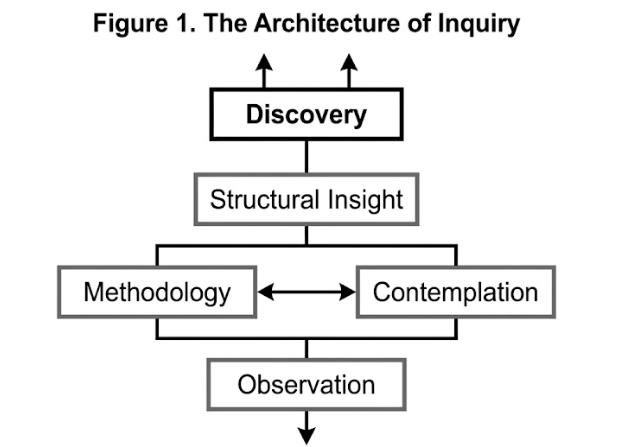
        THE ARCHITECTURE OF INQUIRY

Human  ─────────►  Insight

AI     ─────────►  Formalization

Together ───────►  Discovery
This distinction is not intended as a limitation of AI. Rather, it is an invitation to reflect on the complementary strengths of human intuition and computational reasoning.
An Open Question
These reflections are not presented as a finished theory. Nor are they intended as a critique of empirical science. Empirical science remains our most successful framework for testing and validating claims about the natural world.
Instead, this essay asks a prior question: What is the architecture that makes discovery possible before verification begins?
If methodology explains how knowledge is confirmed, perhaps it is equally worthwhile to explore how genuinely new structures first become visible.
As we continue building increasingly powerful tools for calculation, search, and automation, perhaps one of the enduring questions of inquiry is not simply how we verify, but how we first come to see.
Related Reading: For readers interested in how this perspective extends to the relationship between scientific models and contemplative inquiry, see From Scientific Models to Contemplative Insight:
https://opensourcejournalist.com/from-scientific-models-to-contemplative-insight/
Further Reading
The ideas discussed in this essay intersect with broader historical and philosophical reflections on scientific discovery, mathematical creativity, and the philosophy of science. Readers interested in exploring these themes further may find the following resources useful:
- Henri Poincaré – Mathematical Creation
A classic essay on mathematical discovery, unconscious thought, and creative insight. - Stanford Encyclopedia of Philosophy – Imre Lakatos
An authoritative introduction to Lakatos’ philosophy of scientific research programmes. - MacTutor History of Mathematics – Srinivasa Ramanujan
A historical overview of Ramanujan’s life and extraordinary mathematical contributions.