
Why “Destroyed” Theories Never Actually Disappear
Flat Earth and the Geometry of Limits explains why flatness remains a valid local truth in geometry and engineering, even after the global flat Earth theory was decisively falsified. Few scientific ideas provoke such immediate dismissal as the flat Earth.
Unlike outdated theories that demand careful historical or technical qualification, flat Earth claims are commonly treated as the very definition of ignorance. They are assumed to possess no explanatory power, no predictive utility, and no legitimate scientific domain. If any theory appears to have been truly “annihilated” by modern science, this one seems to qualify.
And yet — this confidence hides something subtle.
The flat Earth did not vanish.
It localized.
Understanding why requires separating global truth from local validity, and recognizing how science actually preserves knowledge through limits rather than erasure.
Flat Earth and the Geometry of Limits
Mathematically, the intuition behind flatness is almost embarrassingly simple.
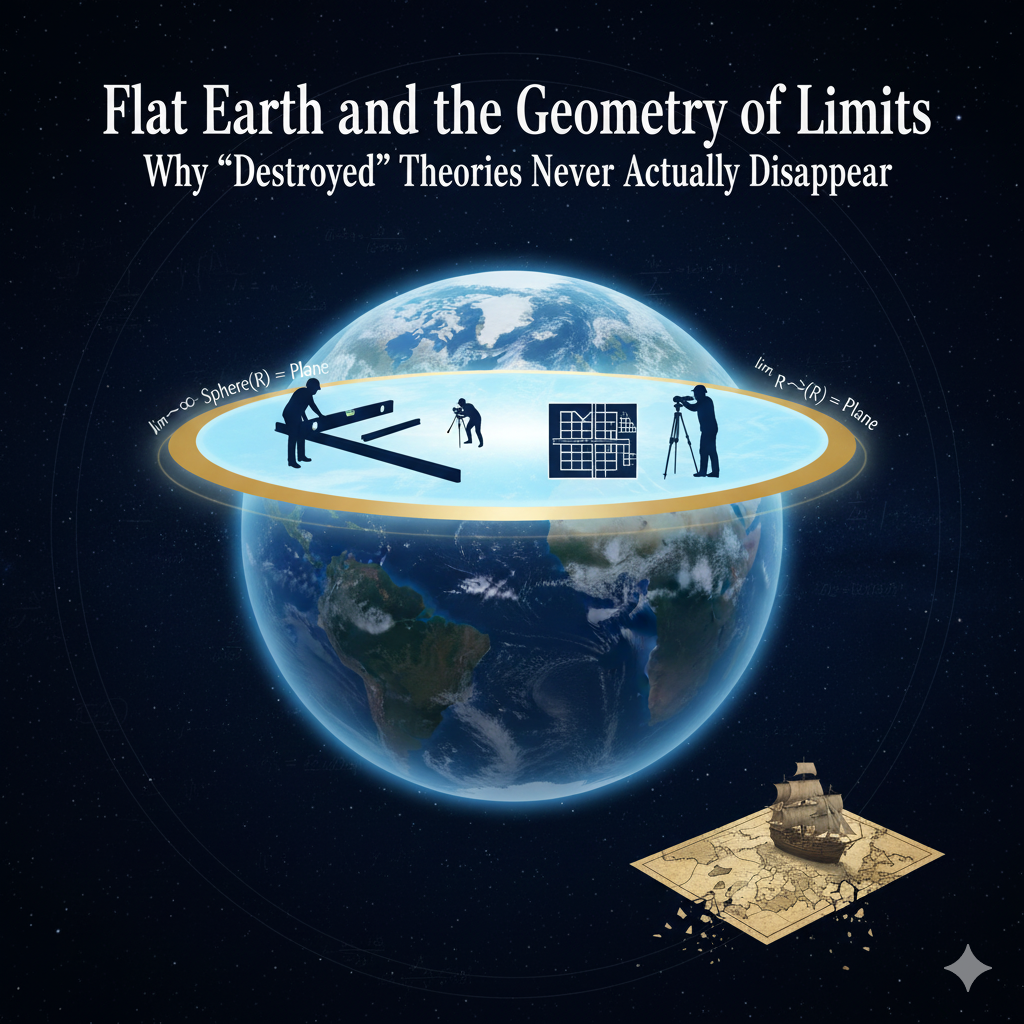
Consider a sphere of radius R. As the radius increases, curvature decreases. In the limit,
A sphere of infinite radius is flat.
This is not metaphor. It is geometry.
Flatness is not an alternative theory of Earth’s shape.
It is the limiting behavior of curvature under scale separation.
What failed historically was not flatness as a concept, but flatness as a global claim.
This is the mathematical heart of Flat Earth and the Geometry of Limits: falsification restricts scope, it does not erase local validity.
Flatness as a Local Invariant (Formal Statement)
This idea can be made precise using differential geometry.
For a sphere of radius R, the Gaussian curvature is
For any fixed local neighborhood ,
As curvature tends to zero, the surface becomes locally indistinguishable from a plane within U.
This formalizes a crucial point:
Flatness is not false — it is the invariant local limit of curvature.
Global geometry determines whether curvature exists.
Local geometry determines whether curvature matters.
Flat models persist because their local invariants survive even when global structure changes.
Engineering Intuition: Flatness in Practice
This distinction is not philosophical abstraction. It is built directly into engineering practice.
As a civil engineer, I know that almost all distance measurements assume flatness. Surveying, construction, road alignment, and structural layout routinely ignore Earth’s curvature unless scale demands otherwise.
This is not oversight. It is precision.
Engineering success depends on knowing which global truths to ignore in order to preserve local stability.
The Spirit Level: Engineering the Local Invariant
One of the most rigorous scientific instruments embodies this idea perfectly: the spirit level.
When a mason or mechanical engineer places a level on a beam, the criterion of correctness is simple: the bubble centers.
At that moment — for that structure — the Earth is flat.
We do not calibrate spirit levels to account for Earth’s curvature (approximately eight inches per mile), because doing so would destroy the very notion of levelness at human scale. A building constructed to follow global curvature would be structurally unsound locally.
This is not a rejection of science.
It is the application of local invariance.
The spirit level works because, within the frame of a construction site, the limit of the sphere is effectively a plane.
Flat Earth as a “Destroyed” Theory That Never Disappeared
From a historical perspective, flat Earth theory appears annihilated:
- No modern scientific domain uses it globally
- No predictive framework depends on it
- No explanatory model survives at planetary scale
And yet flatness itself remains everywhere.
Cartography relies on planar projections.
Engineering relies on local flatness.
Physics relies on tangent spaces.
Mathematics relies on linearization.
What failed was universality — not utility.
The flat Earth was not falsified out of existence.
It was confined to its proper domain.
Localization, Not Erasure
This pattern is not unique.
Newtonian mechanics did not vanish under relativity.
Euclidean geometry did not vanish under curvature.
Classical thermodynamics did not vanish under statistical mechanics.
Each theory survived by becoming local.
Flat Earth thinking followed the same path — except that cultural memory mistook localization for annihilation.
This reveals a broader rule:
Scientific theories rarely die. They are domesticated.
They are taught with conditions, applied with caveats, and embedded within broader frameworks.
Flatness, Logic, and the Boundary of Proof
In an earlier essay, we saw why logic works locally while proof aspires globally.
Flat Earth is a concrete example.
Locally, flatness is logically correct.
Globally, flatness fails.
The error is not believing in flatness.
The error is demanding that flatness remain globally invariant.
Scientific progress does not eliminate local truths.
It restricts their scope.
Invariance as the Survival Criterion
Why did flatness survive when flat Earth did not?
Because invariance survived.
The invariant was not “Earth is flat,” but:
- Local neighborhoods admit planar approximation
- Measurements stabilize under small-scale transformation
- Tangent geometry preserves structure
In the language developed throughout this series:
The eigenvalue changed globally, but remained stable locally.
Flatness passed the invariance test.
Why This Matters Now
In an age of rapid scientific turnover, AI-generated models, and accelerating abstraction, there is a temptation to equate falsification with deletion.
Flat Earth reminds us why that instinct is wrong.
What science discards are unqualified global claims — not the structures that made them intelligible.
Knowledge grows by preserving what survives transformation.
Bridging Forward
In earlier posts, we examined:
- Why logic works locally
- Why scientific theories rarely die
- Why even false claims preserve structure
Flat Earth completes the picture:
It shows how geometry, engineering, and mathematics converge on the same epistemic rule.
Local invariance precedes global correction.
In the next post, we will push this idea further — beyond science — by examining why even incoherent or “mad” speech still reflects internal structure, and why articulation itself is never meaningless.
Closing Reflection
Flat Earth was wrong — but not useless.
It failed as a worldview, not as a local model.
And that distinction explains why science advances without erasing its past.
Truth does not disappear.
It narrows, stabilizes, and survives — one invariant at a time.
Further Articulation
The ideas developed here are part of a broader formal framework presented in:
Pranava Kumar Jha,
Mathematics as Contemplative Science: On the Structural Similarity Between Mathematical and Spiritual Inquiry
Zenodo preprint (2025):
📌 https://zenodo.org/records/18088293
A pictorial overview of this framework is available here:
📌 https://opensourcejournalist.com/mathematics-as-contemplative-science/