
I. Introduction: A Structural Model
The study of highly unpredictable societal shifts demands a new level of analytical rigor. We are proud to introduce a computational laboratory dedicated to Interactive Agent-Based Modeling of Social Systems. This framework, which views society as a Complex Adaptive System, allows users to apply real-world shocks and policies to a network and observe the resulting non-linear dynamics. This exploration bridges the gap between the science of physical systems and the complexity of human interaction.
This challenge forms the basis of the Sociology Science Bridge project. We propose a framework that models society as a Complex Adaptive System (CAS)—where collective behavior emerges dynamically from individual interactions. This interactive model builds upon the theoretical foundation laid out in our previous essay, Can We Predict Society’s Next Move? Bridging the Gap in Social Science. Our goal is to make these abstract concepts tangible.
II. A Structural Model: Interactive Agent-Based Modeling of Social Systems
Below is an interactive simulation built as an Agent-Based Model (ABM). This model allows you to observe how stress is generated, propagated, and adapted to within a simplified social network.
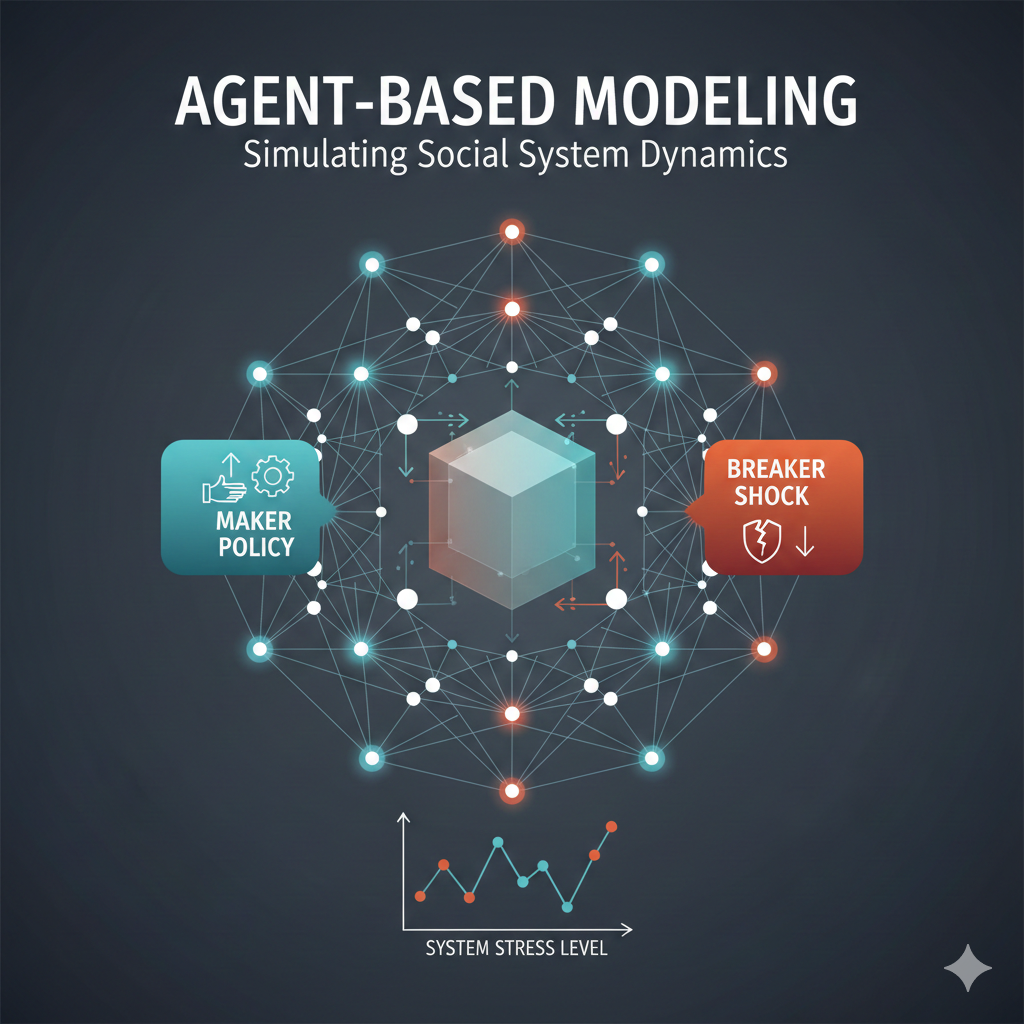
The system features:
- Agents (Nodes): Representing individuals, institutions, or groups, colored based on their internal stress level.
- System Stress Chart: Tracks the overall state of the system over time, showing its attempts to find equilibrium.
We invite you to use the controls to intervene in the system’s dynamics.
III The Live Simulation
Ready to stress-test the network? The best way to understand the complex, non-linear dynamics of Agent-Based Modeling Social Systems is by running the simulation yourself. Below, click the button to launch the full-screen interactive environment.
IV. Controlling the System: Testing Policy Interventions in Interactive Agent-Based Modeling
The buttons are designed to allow you to apply different types of forces to the system:
- Apply Acute Shock: Introduces a sudden, localized stress event to a few random agents. Observe how this energy flows through the network and challenges the system’s stability.
- Apply Policy Intervention: Simulates a deliberate, constructive action designed to foster system-wide stability and promote long-term adaptive responses.
- Ease Systemic Pressure: Represents a targeted, immediate action to reduce high stress levels across the board, aiming to restore balance quickly.
Experiment with these forces and observe the results on the System Stress Level Chart. Does the system fracture, or does it adapt? The resulting pattern reveals the non-linear nature of complex social systems.
V. Concluding Notes and Further Reading
This visualization is the practical demonstration of the theoretical work being developed for the book, Society in Tensors.
This project is guided by the principle that mathematics is the unifying language across seemingly disparate fields. We apply the rigor of engineering principles to analyze social structures and predict transformation.
For full methodological notes, ethical guidelines, and acknowledgments of the AI tools used in the synthesis of this project, please visit the About Us Page.