
Mathematics as Contemplative Science: The Framework for Unity

The prevailing paradigm treats mathematics merely as a tool for science, resulting in a persistent epistemological boundary and contributing to issues like math anxiety (the high $D_{\text{process}}$). This visualization introduces the Contemplative Mathematics Framework, proposing a shift from the traditional separation model to a unified system of Dynamic Invariance. We compare the AS-IS (Separation) state with the TO-BE (Unity) state, showing how the discipline can be re-engineered to seek invariant truth ($\lambda=1$). For an exploration of how the principles of this framework, particularly the concepts of Actual Infinity and Invariance, can be deeply applied within Indian Spiritual Contexts, please visit Ramrahasya.com.
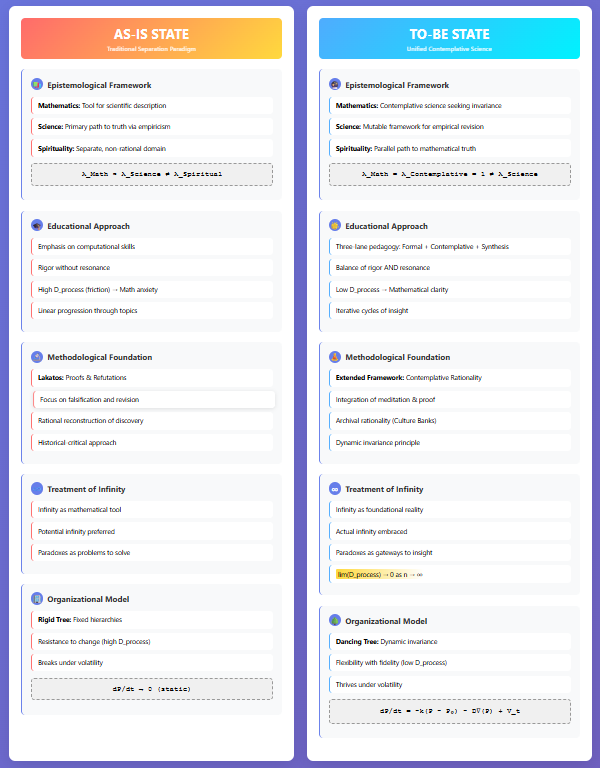
Comparison grid visualizing the Contemplative Mathematics Framework: AS-IS separation versus TO-BE unified mathematical epistemology
The Contemplative Mathematics Framework: A paradigm shift from separation to unity.

Mathematics as Contemplative Science

Framework Extension: From Separation to Unity

AS-IS STATE

Traditional Separation Paradigm

๐Ÿ“š Epistemological Framework

Mathematics: Tool for scientific description
Science: Primary path to truth via empiricism
Spirituality: Separate, non-rational domain
$$\lambda_{\text{Math}} \approx \lambda_{\text{Science}} \neq \lambda_{\text{Spiritual}}$$

๐ŸŽ“ Educational Approach

Emphasis on computational skills
Rigor without resonance
High \( \mathcal{D}_{\text{process}} \) (friction) โ†’ Math anxiety
Linear progression through topics

๐Ÿ”ฌ Methodological Foundation

Lakatos: Proofs & Refutations
Focus on falsification and revision
Rational reconstruction of discovery
Historical-critical approach

โ™พ๏ธ Treatment of Infinity

Infinity as mathematical tool
Potential infinity preferred
Paradoxes as problems to solve

๐Ÿข Organizational Model

Rigid Tree: Fixed hierarchies
Resistance to change (high \( \mathcal{D}_{\text{process}} \))
Breaks under volatility
$$\frac{d\mathbf{P}}{dt} \rightarrow 0 \quad \text{(static)}$$

TO-BE STATE

Unified Contemplative Science

๐Ÿ”ฎ Epistemological Framework

Mathematics: Contemplative science seeking invariance
Science: Mutable framework for empirical revision
Spirituality: Parallel path to mathematical truth
$$\lambda_{\text{Math}} = \lambda_{\text{Contemplative}} = 1 \neq \lambda_{\text{Science}}$$

๐ŸŒŸ Educational Approach

Three-lane pedagogy: Formal + Contemplative + Synthesis
Balance of rigor AND resonance
Low \( \mathcal{D}_{\text{process}} \) โ†’ Mathematical clarity
Iterative cycles of insight

๐Ÿง˜ Methodological Foundation

Extended Framework: Contemplative Rationality
Integration of meditation & proof
Archival rationality (Culture Banks)
Dynamic invariance principle

โˆž Treatment of Infinity

Infinity as foundational reality
Actual infinity embraced
Paradoxes as gateways to insight
$$\lim_{n \to \infty} \mathcal{D}_{\text{process}} = 0$$

๐ŸŒณ Organizational Model

Dancing Tree: Dynamic invariance
Flexibility with fidelity (low \( \mathcal{D}_{\text{process}} \))
Thrives under volatility
$$\frac{d\mathbf{P}}{dt} = -k(\mathbf{P}-\mathbf{P}_0) – D\nabla(\mathbf{P}) + \mathbf{V}_t$$

๐ŸŒ‰ The Bridge: Key Transformations

How the framework extends from AS-IS to TO-BE

From Separation to Convergence

Mathematics and contemplation converge toward the same Axiomatic Eigenvector \( \mathbf{P} \)

From Static to Dynamic

Invariance preserved through flexibility, not rigidity

From Anxiety to Resonance

Reducing \( \mathcal{D}_{\text{process}} \) transforms math into clarity

Core Innovation: The Unified Equation

$$\frac{\partial \mathbf{P}}{\partial t} + \nabla \cdot (\mathcal{D}_{\text{process}}\mathbf{P}) = -\mu(\mathbf{P}-\mathbf{P}_{\text{target}})$$

Understanding evolves toward invariant truth through friction reduction

For a deeper dive into the mathematical models used to predict societal evolution and bridge gaps in social science using these dynamic principles, explore our related analysis: Can We Predict Societyโ€™s Next Move? Bridging the Gap in Social Science.